
Par
Thomas Didier
Fractional CMO @Asteria
Asteria & Oxford TIDE: Biomimicry to accelerate the energy transition
The energy challenge: looking for new models
Across every industry, the energy transition is forcing a profound rethink.
How can we store energy more efficiently? Transport it with less loss? Capture and convert it cleanly, safely, and at scale?
To better understand these challenges, Oxford TIDE recently conducted a study among 300 industrial leaders. The findings were remarkably consistent: four recurring themes emerged as priorities: Energy Generation, Storage, Efficiency, and Transmission.
Each of these areas poses complex, systemic questions that transcend traditional engineering. And yet, every one of them has already been solved… somewhere in nature.
From the way plants harvest light to the bioelectricity of electric eels or the collective intelligence of bee colonies, living systems offer elegant, proven strategies for managing energy with minimal waste.
The question is no longer whether these biological models exist, but how we can translate them into scalable, real-world solutions.
From observation to application: a collaboration born from shared ambition
That question sits at the heart of a new partnership between Oxford TIDE and Asteria, the world’s largest platform dedicated to unlocking nature-inspired innovation through artificial intelligence.
Asteria was born from four years of scientific research within Ceebios, the French center for biomimicry, and is now an independent startup.
Its mission is simple yet ambitious: to map the knowledge hidden in nature’s 3.8 billion years of R&D and make it actionable for today’s innovators.
The Asteria platform analyzes data from a vast scientific corpus - over 1.5 million peer-reviewed articles, 680,000 biological mechanisms, and 220,000 biomimetic patents - with AI-powered exploration tools.
This framework allows industries and researchers to identify how biodiversity can inspire new technologies, materials, and processes.
For Oxford TIDE, a research center focused on sustainable industrial development and inclusive economic transformation, this collaboration is an opportunity to address a critical question: How can biomimicry accelerate the energy transition and ensure fair benefit-sharing with communities in biodiverse regions?
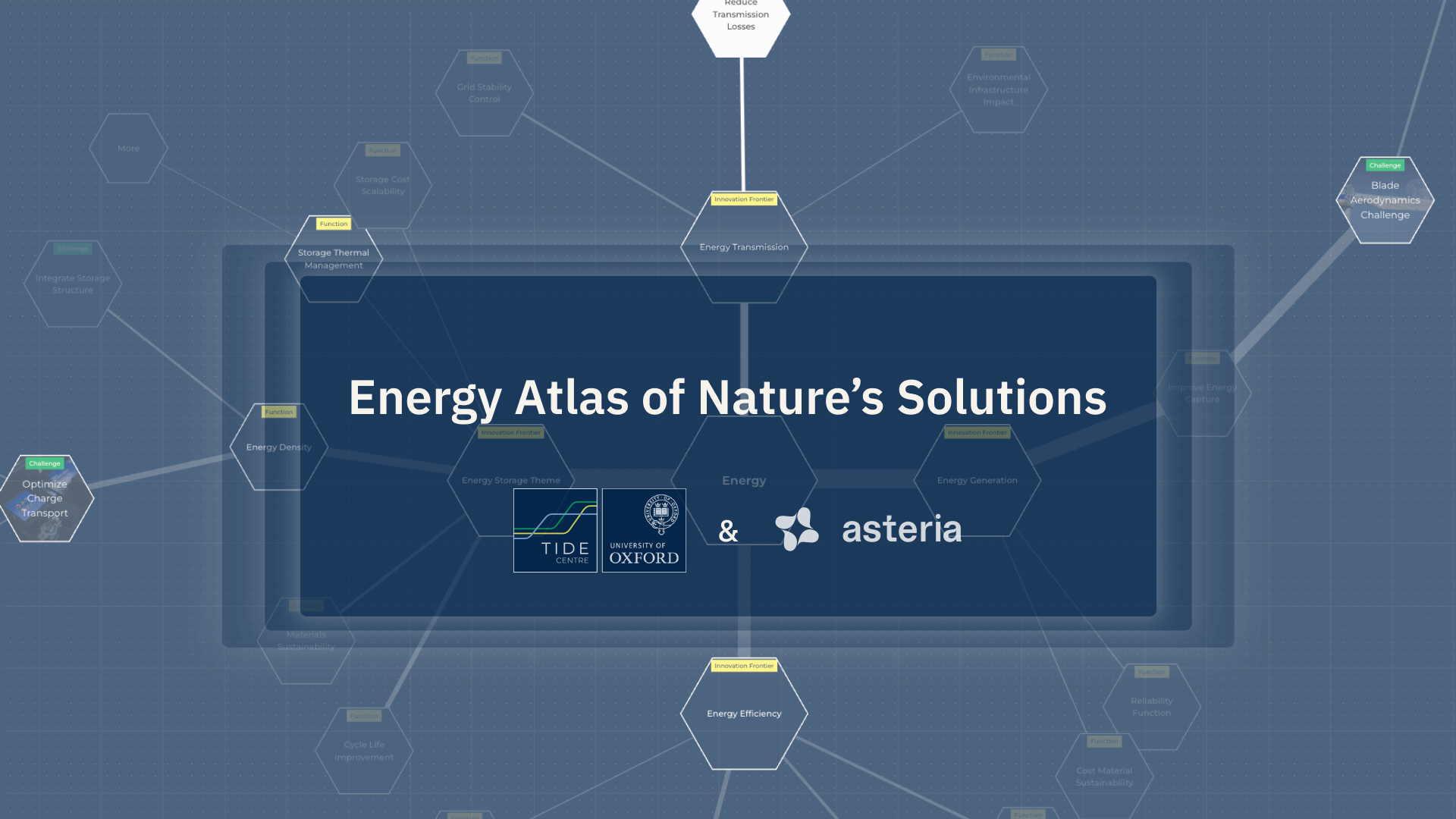
Together, Asteria and Oxford TIDE have developed The Energy Atlas of Nature’s Solutions: an open-access interactive visualization of nature-inspired insights for energy innovation.
The Atlas showcases initiatives, case studies, and a selection of AI-generated analyses from Asteria’s platform, freely available to inspire researchers, innovators, and policymakers.
“Rather than imposing our industrial systems on nature, why not let nature influence our industrial and innovation systems?” Amir Lebdioui, Director of the TIDE Centre, University of Oxford
A practical tool for industry transformation
For companies operating in energy-intensive sectors, this collaboration offers more than inspiration. It’s a pathway toward transformation.
The Energy Atlas of Nature’s Solutions is designed as a dynamic tool, evolving as users engage with it.
Indeed, it is an interactive showcase illustrating how nature can inspire the energy transition. Born from a study of 300 industrial leaders, the Atlas addresses four critical priorities: Energy Conversion, Transport, Storage, and Collection.
Through 20 biological models and 15 innovation insights, it demonstrates how challenges already solved in nature, from the way plants harvest light to the bioelectricity of electric eels, can inform industrial solutions. Think of it as a window into what's possible when biomimicry meets energy innovation.
The Atlas showcases this approach in action, offering concrete examples of how ecosystems have mastered efficiency, adaptation, and regeneration over billions of years.
Behind this Atlas lies Asteria's platform, over 4 million scientific articles and 680,000 biological mechanisms mapped by AI, ready to help organizations explore nature-inspired innovation at scale.
For industrial leaders, this isn’t about copying nature superficially. It’s about rethinking innovation systems to become more adaptive, regenerative, and resource-efficient, just like the ecosystems that sustain us.
Beyond the Atlas: redefining innovation through biomimicry and AI
The collaboration between Asteria and Oxford TIDE is a pilot project, but its implications reach far beyond the energy sector.
It illustrates a new way of working, one where AI acts as a bridge between biological knowledge and industrial application.
Rather than seeing nature as a resource to extract from, Asteria’s approach turns it into a database of design intelligence.
"The problem isn't that solutions aren't possible, nature shows us they are. The problem is much simpler and humbling, most of the time, we just don't know how to do it yet. And that's a thrilling realisation in a time when we're so lost, to understand that we only have to be quiet and learn." Eliot Graeff, CEO & Cofounder at Asteria
As industries confront planetary limits, the question is no longer whether we should work with nature but how fast we can learn from it.
By mapping scientific knowledge at an unprecedented scale, Asteria’s platform allows organizations to:
- anticipate sustainable design opportunities before they emerge,
- identify existing biomimetic patents and avoid redundant R&D,
- and build innovation strategies rooted in systems thinking rather than linear extraction.
This is what makes the collaboration with Oxford TIDE so powerful: it bridges the rigor of academic research with the agility of industrial application.
Showing that biomimicry, powered by AI, can be both scientifically credible and operationally actionable.
Explore the Atlas and join the movement
The Energy Atlas of Nature’s Solutions is freely accessible online.
It offers a glimpse of what’s possible when technology, science, and nature converge toward a common goal: designing systems that are not only efficient, but alive with intelligence.
To collaborate on a similar project or learn more about Asteria’s platform, contact us.
About
Technology and Industrialisation for Development (TIDE) Centre, University of Oxford)
The Technology and Industrialisation for Development Centre explores the complex relationships between trade, investment, technology, industrialisation, and innovation in the context of development.
Asteria
The world’s largest AI-powered platform for nature-inspired innovation. Built on four years of scientific research and now an independent startup, Asteria uses AI to map and translate biological intelligence into actionable insights for industry, research, and policy.
Frequently asked questions about biomimicry innovation
It is an open-access interactive tool created by Asteria and Oxford TIDE. It visualizes nature-inspired insights for energy innovation. It includes biological models, case studies, and AI-generated analyses that help industries explore new solutions in energy conversion, transport, storage, and collection.
Nature has already solved many energy challenges. Plants harvest light with high efficiency. Electric eels generate and control electricity. Bee colonies optimize energy flows. The Atlas and Asteria’s platform show how these models can guide new technologies and systems that are more efficient, adaptive, and regenerative.
Asteria maps biological intelligence at scale. It combines more than 1.5 million scientific articles, 680,000 biological mechanisms, and 220,000 biomimetic patents. Its AI tools help users spot opportunities, avoid redundant R&D, and design solutions based on systems thinking instead of extraction.
The collaboration supports a shared goal. Oxford TIDE focuses on sustainable industrial development and fair benefit-sharing. Asteria provides the scientific and AI infrastructure to make nature-inspired innovation actionable. Together, they explore how biomimicry can support the energy transition while benefiting communities in biodiverse regions.
The Atlas is a starting point for identifying nature-inspired strategies relevant to energy challenges. Companies can explore biological models, review example insights, and use Asteria’s platform to go deeper. It helps them rethink systems, improve efficiency, and build solutions aligned with long-term sustainability.

More posts about
Impact Stories

Collaborate with nature
GET a demo


.png)