
Par
Eliot Graeff
CEO & Co-founder @Asteria
What's biomimicry? A guide to nature-inspired strategies
When Microsoft looked to human biology to cool their AI
In 2024, Microsoft successfully tested a micro-fluidic cooling system for AI chips that removed heat up to three times better than cold plates, an advanced cooling technology commonly used today.
The system uses tiny channels etched directly into the silicon chip, creating grooves that allow cooling liquid to flow directly onto the chip. An approach that brings liquid coolant directly inside the silicon where the heat is generated.
The design incorporated patterns inspired by vein structures in leaves and butterfly wings, which allow more efficient distribution of fluids.
This biological approach to a critical engineering challenge exemplifies what biomimicry can achieve.
Welcome to the discipline where answers to our most pressing technical problems have been refined over billions of years of biological evolution.
What does biomimicry actually mean?
In 2015, to further structure this emerging field of interest, an ISO committee of experts developed a strict linguistic definition of the most common, and often mixed-up, terms referring to the field: bio-inspiration, bionics, biomimicry and biomimetics [ISO/TC266, 2015].
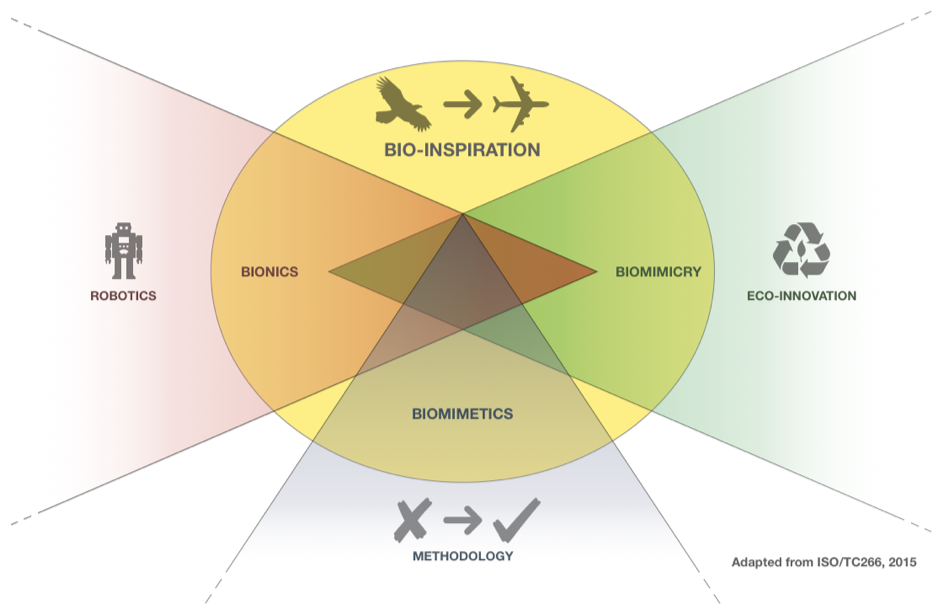
- Bionics as the ability to be inspired by living beings to replace or enhance a biological function through Robotics.
- Biomimicry as the philosophical field which aims at learning from living beings in order to design in a more sustainable way. Its main idea is to reconnect our innovative strategies and expectations with inherent ground rules imposed by our finite world, its delicate inorganic balance and the highly sensitive ecosystems it shelters.
- Biomimetics as the methodological aspect linked with biomimicry, appears as a crucial element in the spread and implementation of such new practices. Biomimetics is defined as “the interdisciplinary cooperation of biology and technology or other fields of innovation with the goal of solving practical problems through the function analysis of biological systems, their abstraction into models and the transfer into and application of these models to the solution”.
For Asteria, we only use the term biomimicry when it is paired with its methodological counterpart, biomimetics. In this context, biomimicry refers to the disciplined study of nature-inspired strategies and their application to human challenges in a sustainable way.
Biomimicry, from the Greek bios (life) and mimesis (imitation).
True biomimicry demands scientific precision, not superficial aesthetics:
- Deep observation of biological systems : what are biological facts ? The structural, behavioral, organizational or material insights we can observe in the living ?
- Abstraction of the underlying mechanisms : how biological mechanisms work and based on what scientific rules ? How can we generalize those rules to formalize operating and design principles commonly referred to as "life-inspired strategies*".
- Translation into functional human technologies and services : how those principles and scientific models can be applied and adapted to the specific set of constraints of a given innovative project to generate biomimetic solutions.
- Validation of functional efficiency, sustainability and regenerative potential.
Janine Benyus formalized this approach in her groundbreaking 1997 book Biomimicry: Innovation Inspired by Nature.
Since then, the field has evolved from inspiration to discipline, bridging biology, materials science, engineering, and systems thinking and esteemed academic institutions from all over the world, such as the Fraunhofer Institute, Georgia Tech, MIT, Standford, Berkley, Oxford, National Museum of Natural History (MNHN), Centrale Lyon, École Polytechnique…, supported the development of biomimetic technologies and knowledge.
The key insight? Observing the living world doesn't just provide pretty metaphors. It offers insights into biological mechanisms that have been selected through the ultimate stress test : natural selection.
*As continuously underlined by various research groups, including the experts of the Paris MNHN, one should be very careful about the semantics used. The risk being giving the living an intention that doesn't exist. Keep in mind that the strategies in biomimetic are "inspired" by the principles observed in nature, rather than being actual "biological strategies". This is a subtle yet important distinction : humans get inspired by what they observe; nature doesn't aim for anything.
Where do nature-inspired solutions get their robustness from?
All organisms are constantly exposed to different kinds of constraints, either from other living beings (such as predators, parasites, or competitors) or from physical and chemical factors in their environment (like temperature, pressure, or the nature of their habitat).
Together, these factors create what we call evolutionary pressure. Organisms that are better adapted to their environment have a higher chance of surviving and reproducing, and therefore of passing on their traits.
This “pressure” shapes how populations evolve by favoring traits that increase fitness, the ability to survive and pass on genes, while reducing the presence of traits that are disadvantageous.
Over time, this dual process leads to the adaptation of populations.
The longer a population is exposed to a given constraint, the more it adapts, eventually reaching a “good enough” mechanism that allows it to function and persist under those conditions.
From this perspective, the living world can be viewed as a vast reservoir of mechanisms that have endured continuous evolutionary pressure.
These mechanisms can inspire humans to solve problems in similar ways.
It is important to remember, however, that current organisms are adapted to today’s conditions. Much of the past biodiversity disappeared not because it was less adapted in general, but because it was not suited to the environmental conditions that exist now.
Within this context, what emerges of key interest for biomimicry is the commonalities that exist between various organisms from very distant species. These evolutionary convergences give us insight into how the living adapted to the transversal constraints of life on earth.
Amongst other life-inspired principles:
- Degradability of biological systems into their molecular building blocks, allowing continuous availability through material cycles
- Additive manufacturing through the combination of building blocks only where necessary, which we can hypothesize, is an advantage in reducing the need for resources.
- Multifonctionality of structures, that we can also hypothesize as an advantage in reducing the need for resources.
- Locally sourced materials, because it's simply what's available in the environment where they evolved.
- Use passive mechanisms when possible to reduce the need for energy.
Why do we consider biomimetic solutions to be sustainable?
As previously discussed, biological species evolve to survive and thrive under the constraints of their environment. These constraints include the availability of resources and the physicochemicals conditions in which they live.
In most cases, organisms do not have access to large quantities of rare metals, extreme pressures or temperatures, or vast amounts of energy.
As a result, biological functions often emerge through mechanisms that inherently require minimal or common materials and low energy expenditure.
Similarly, biological systems tend to be composed of materials that are readily available in their environment and are often biodegradable, allowing material redistribution.
Together, these constraints have shaped evolutionary processes to favor solutions that operate efficiently under low-impact, resource-limited conditions, often in stark contrast to many human-engineered technologies, which rely on scarce materials and high energy inputs.
It is important to note, however, that bio-inspired mechanisms are not inherently sustainable (biological mechanisms are).
Coral reefs form complex structures without producing toxic by-products.
Termite mounds maintain stable internal temperatures without external energy inputs.
Butterfly wings are colored through nanostructuring of chitin rather than mineral or metal-based pigments.
Pinecone open passively under hydrometric fluctuations.
These are just a few examples of biological systems that achieve remarkable functions through the efficient use of locally available resources.
While biological systems have evolved to function with minimal environmental impact, humans are the ones choosing how to implement these ideas.
It remains the responsibility of innovators to apply bio-inspired solutions using sustainable materials and processes to ensure truly low-impact outcomes.
What to get inspired from in biology?
Biomimicry works across multiple dimensions simultaneously. Engineers and designers may be inspired by biological systems based on their :
- Form: The kingfisher's beak inspired the Shinkansen bullet train's nose design. This shape enabled the 500-series to reduce air pressure by 30% and electricity use by 15%, even though speeds increased by 10% over the former series.
- Process: Pinecone opens passively under hydrometric fluctuations, leading to new passive deployable materials for space or aeronautics.
- Material: Spider silk is tougher than Kevlar for its weight, and it forms itself at room temperature using only water-based proteins.
- Behavior: Ant colonies solve complex logistics problems through simple individual rules, now applied in optimization algorithms.
- Ecosystem organization: Forests share nutrients through fungal networks, creating resilience through cooperation rather than competition.
Most biomimetic breakthroughs happen when innovators think across these dimensions simultaneously.
Biomimicry applications in use today
In buildings: Passive cooling systems modeled on termite mounds can dramatically reduce HVAC energy consumption, as demonstrated by Michael Pawlin in the Eastgate center.
In medicine: Cardiac pumps such as CorWave’s wave‑membrane design, inspired by undulating biological systems, aim to reduce complications and better preserve blood integrity by providing a pulsatile flow nearer to the native heart.
In energy: Wind turbine blades with tubercles (bumps) inspired by humpback whale fins demonstrated an efficiency gain of roughly 20% when applied to wind turbines. Tests showed that incorporating tubercles could increase the maximum lift of a wing while delaying stall at high angles of attack by up to 40%.
In cosmetics: Pigment and mineral-free coloring powder, based on the nanostructures at the surface of the morpho butterfly wings, Sparxell manufacture the first structural color 100% composed of cellulose crystals.
In data centers: Microsoft's micro fluidic cooling reduced the maximum temperature rise of GPU silicon by 65%, though this varies by chip type.
The biomimicry process and practice
Three main biomimetic approaches can be considered: the solution-based, organism-based and problem-driven approach.
A solution-based approach starts with a biological model that appears of great interest in performing a given function. Practitioners then use the following process:
- Biological analysis: Deeply understand the biological functional solution and how it works.
- Principle extraction: Abstract the mechanisms into a model that explains how the function emerges, thanks to which scientific laws and under which operating conditions.
- Technological prospection: Identify, through interviews and market research, which challenges could gain the most from these functional strategies.
- Emulation: Translate biology into engineering through several creative steps and the adaptation of the biomimetic solutions to the initial technological context.
- Prototyping & Evaluation: Build prototypes of biomimetic concepts. These can be digital, such as 3D models, or physical. Their purpose is to evaluate the concept through simulations or user testing. Assess both performance and sustainability.
- Scaling: Refine the concepts so they align with industrial materials, manufacturing processes, and supplier requirements.
An organism-based approach is quite similar to the solution-based approach with the difference that you don't know what system and function to emulate from the given organism.
This approach is often used by cosmetics industries that have access to specific biological resources but don't know how to get inspired by them:
- Functional analysis: Define all functions associated with a given biological system.
- Technological prospection: Use interviews and market research to identify which challenges could benefit from the range of identified functions, then select one for deeper investigation.
- Principle extraction: Turn the mechanisms into an abstract model that explains how the function emerges, which scientific laws drive it, and under what operating conditions it works.
- Emulation: Translate biological insights into engineering solutions through iterative creative steps, adapting each biomimetic idea to the target technological context.
- Prototyping & Evaluation: Build prototypes of biomimetic concepts. These can be digital, such as 3D models, or physical. Their purpose is to evaluate the concept through simulations or user testing. Assess both performance and sustainability.
- Scaling: Refine the concepts so they align with industrial materials, manufacturing processes, and supplier requirements.
Launching a problem-driven biomimetic innovation project is similar to using a solution-based approach, with two key differences: you start the project with an industrial challenge you want to address, but you do not yet know which biological model will inspire the solution.
As a result, the process evolves in the following way:
- Challenge framing: Define your problem and perform deep problem analysis to ensure a proper understanding of the need to meet and the technological challenges to solve.
- Biological research: Identify biological systems presenting solutions to your challenges.
- Principle extraction: Turn the mechanisms into an abstract model that explains how the function emerges, which scientific laws drive it, and under what operating conditions it works.
- Emulation: Translate biological insights into engineering solutions through iterative creative steps, adapting each biomimetic idea to the target technological context.
- Prototyping & Evaluation: Build prototypes of biomimetic concepts. These can be digital, such as 3D models, or physical. Their purpose is to evaluate the concept through simulations or user testing. Assess both performance and sustainability.
- Scaling: Refine the concepts so they align with industrial materials, manufacturing processes, and supplier requirements.
How is Asteria supporting biomimicry process and practice?
At Asteria, we're building the infrastructure supporting teams throughout these various processes:
- The different methodological steps are infused into the user flow to guide practitioners depending on their needs.
- The largest scientific and industrial database dedicated to nature-inspired innovation, with 4+ million articles, 680,000 biological strategies and 220,000 bio-inspired patents.
- A database of biomimetic technologies, materials and manufacturing processes to support concrete development.
We're giving innovators the ability to navigate biological knowledge at the speed of innovation.
That's the shift we're enabling: from biomimicry as a niche specialty to biomimicry as a standard innovation methodology.
The future is already evolving
Biomimicry isn't new, but the urgency is. Climate disruption, biodiversity loss, and resource scarcity are reshaping markets, regulations, and expectations now.
For the first time, tools exist to make biological-inspired intelligence available to any innovator, anywhere, working on any challenge.
Somewhere right now, an architect is learning from a termite mound how to eliminate the need for air conditioning. A surgeon is observing a mussel to understand how to repair tissue underwater. A logistics manager is discovering, through the example of a forest, how decentralization creates resilience.
Nature has been solving your problems for eons.
Are you ready to learn?
👉 Explore Asteria's biomimicry platform or discover our industry use cases to see how nature can accelerate your next breakthrough.
Frequently asked questions about biomimicry innovation
Biomimicry is the philosophical approach of learning from living beings to design sustainable solutions. Biomimetics is the methodological process of analyzing biological systems, abstracting principles, and applying them to human technologies. Bionics focuses on using inspiration from living beings to replace or enhance biological functions through robotics. At Asteria, biomimicry is always paired with biomimetics for practical, sustainable innovation.
Biological systems evolve under resource-limited conditions, often using locally available materials, low energy, and biodegradable components. By translating these mechanisms into human technologies, innovators can create solutions that minimize environmental impact, reduce resource use, and operate efficiently under constraints. True sustainability depends on careful implementation by humans.
There are three approaches:
- Solution-based: Start from a biological model and adapt it to solve a technical problem.
- Organism-based: Start from an organism and analyze all its functions to identify potential applications.
- Problem-driven: Start from an industrial challenge and identify which biological systems provide relevant solutions.
Each approach guides the design process depending on whether you have a known biological inspiration or a defined problem.
Key principles include: multi-functionality, additive construction only where needed, use of passive mechanisms, local sourcing of materials, and degradability. Evolutionary convergences across species show strategies that endure environmental pressures, providing insights for resilient and adaptable human solutions.

More posts about
Biomimicry made simple


Collaborate with nature
GET a demo