

Par
Nicolas Morand
CPO @Asteria
Asteria Chat: balancing scientific rigor and R&D flexibility in biomimicry
Biomimicry often starts with genuine excitement. Nature has solved problems we still struggle with: thermal regulation, surface durability, material efficiency… On paper, it feels like an obvious source of innovation. And yet, in many industrial R&D teams, biomimicry projects quietly fade away after the first attempt. Not because nature failed. But because exploring it seriously is harder than it looks.
The real challenge of starting a biomimicry project
When we speak with R&D teams, the same two difficulties come up again and again: how to translate concrete engineering problems into relevant biological questions, and how to do so fast enough to fit industrial R&D timelines.
Translating engineering problems into biological questions
Engineering problems are concrete. You know your targets, constraints, materials, and processes.
Biology is different. It does not speak the language of specifications or CAD models.
Knowing how to reframe a technical problem into a meaningful biological question is a skill in itself:
- Where in the living world should you look?
- Which organisms matter?
- Which mechanisms are worth exploring?
Most teams do not have this expertise internally.
The growing pressure to move fast and scale
Teams cannot afford to spend weeks chasing weak biological leads.
This leads to familiar patterns:
- Time is lost exploring paths that turn out to be biologically irrelevant.
- Early excitement built on elegant but fragile analogies.
- One bio-inspired concept fails feasibility review.
- Biomimicry gets labeled “interesting, but not for us”.
The conclusion is understandable but often wrong. The real issue is not inspiration. It is how to explore the living world quickly, rigorously, and in a way that can scale across projects.
Why generic AI tools struggle with biomimicry
Many teams turn to generic AI tools hoping to solve this.
The intention makes sense, but the result is often disappointing. Generic AI prioritizes fluency, whereas biomimicry fundamentally relies on scientific rigor.
Plausible answers are not enough
In biomimicry, small inaccuracies matter.
Generic AI does not reliably distinguish between:
- well-documented biological mechanisms,
- partial or context-specific evidence,
- speculative or metaphorical inspiration.
Early on, this creates unwarranted confidence. Later, it creates rework.
Too much convergence, too early
Effective biomimicry starts broadly. It maps mechanisms before selecting candidates.
Generic tools tend to converge quickly and to showcase:
- the same iconic organisms,
- the same familiar stories,
- the same narrow solution space.
It feels efficient. Methodologically, it is risky.
Blind spots around scalability and IP
Generic tools rarely ask uncomfortable questions such as:
- Can this mechanism scale industrially?
- Does it depend on rare conditions or living materials?
- What are the intellectual property implications?
These questions matter. Ignoring them early makes projects fragile later.
What is Asteria Chat designed for?
Asteria Chat was built with a clear intention. It is not here to automate innovation but to support biomimetic reasoning under real industrial constraints. Our new product can help teams:
- Ask better biological questions before searching for answers.
- Explore biology by function and mechanism, not by reputation.
- Structure exploration using established biomimicry methodology.
- Slow teams down at the right moments, by challenging assumptions.
It does not replace engineers nor experiments.
Our AI assistant helps teams focus their effort where it actually creates value.
A scientific foundation you can trust
The rigor behind Asteria Chat is not accidental. It is the result of a deliberately structured scientific and industrial foundation. Behind the interface sits a unique knowledge backbone designed specifically for biomimicry in R&D:
- 60,000+ biological models, describing the mechanisms of the living world in a precise, structured, and accessible way.
- 1+ million scientific articles indexed from trusted academic and institutional sources.
- 1.3+ million publications pre-selected by AI for their relevance to biomimicry and functional inspiration.
- 300,000 index bio-inspired patents, anchoring biological exploration in real industrial use cases and market realities.
This content is continuously enriched and updated as new research and innovations emerge.
The result is a living ecosystem that connects biological mechanisms, scientific evidence, and industrial applications, allowing teams to explore the living world with both rigor and pragmatism.
This matters because biomimicry tends to fail when exploration is either scientifically fragile or disconnected from feasibility, scalability, and industrial constraints.
How Asteria Chat fits into real R&D work
Starting from a real engineering problem
Asteria Chat helps teams step back from solutions and focus first on framing the right biological question. The goal is not answers yet, it is framing the right question.
Example prompt: “I’m working on a wind turbine blade coating that must resist erosion without relying on non-sustainable polymers. Can you help me reframe this as a biological question?”
Exploring biological strategies, not anecdotes
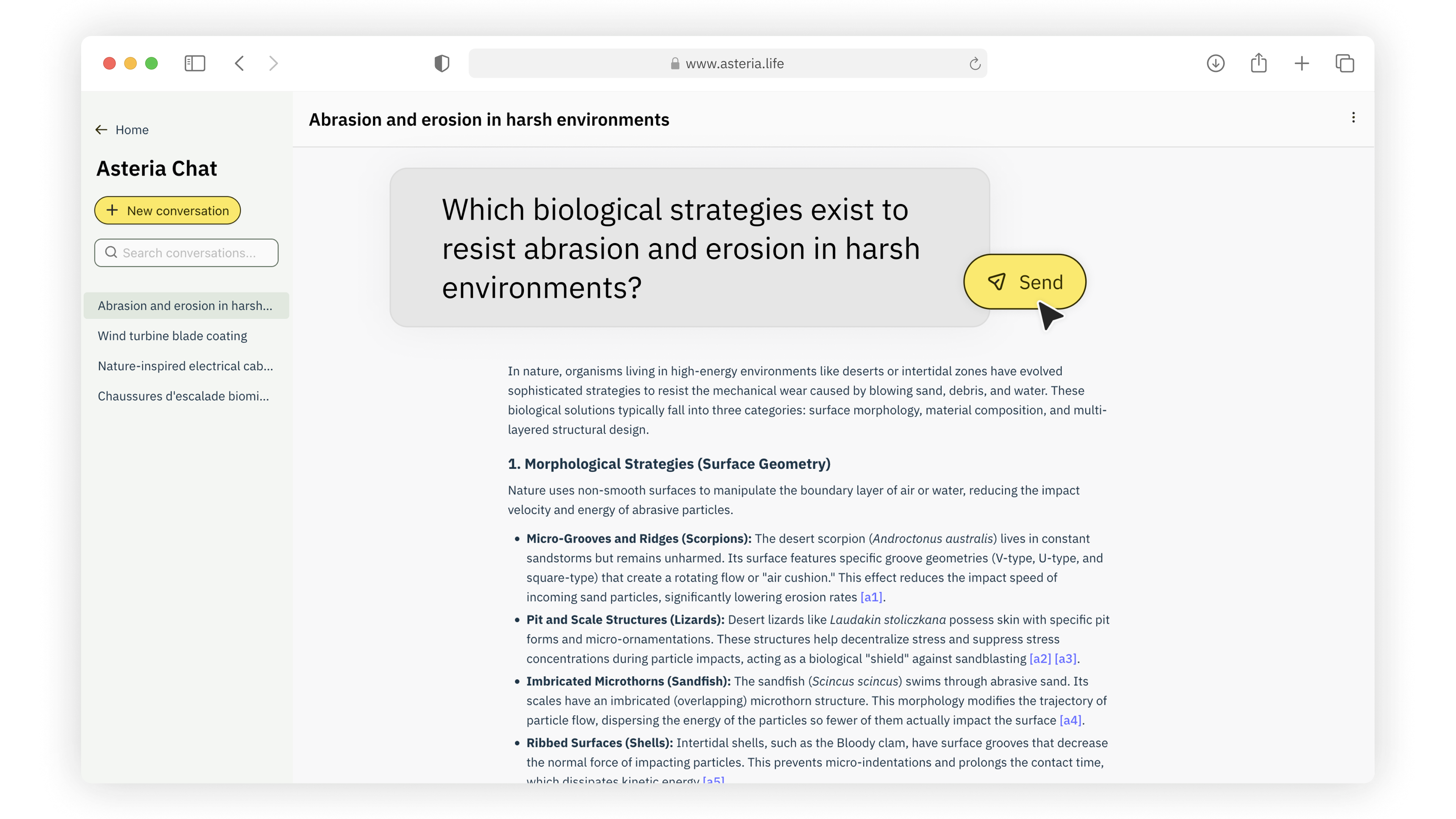
Asteria Chat supports biological exploration that goes beyond iconic organisms and familiar biomimicry examples, opening up a broader, structured, and mechanism-driven view of the living world, and avoiding early fixation on anecdotal inspiration.
Example prompts: “Which biological strategies resist abrasion and erosion in harsh environments?” or “Which organisms maintain surface integrity under repeated mechanical stress?”
Mapping the patent landscape early
Before going further, Asteria Chat can connect exploration to existing innovation. The assistant is connected to a curated database of bio-inspired patents sourced from Google Patents. This enables early-stage patent intelligence around a given biological strategy or functional theme.
This helps teams:
- identify existing solutions and avoid blind spots,
- assess market and technology maturity,
- distinguish unexplored directions from crowded spaces.
Example prompts: “Which bio-inspired patents already exist around erosion-resistant surfaces?” or “What do these patents suggest about technology maturity and active R&D directions?”
Adding friction before it gets expensive
Before enthusiasm turns into commitment, Asteria Chat deliberately slows teams down, keeping evaluation critical, grounded, and constraint-aware ; and allowing weak ideas to surface early, before they become costly.
Example prompts: “What are the limitations of these strategies when transposed to industrial materials?” or “Which environmental conditions are critical for these mechanisms to work in nature?”
Supporting early concepts, without overpromising
When teams start forming early concepts, Asteria Chat supports ideation without blurring the line between inspiration and technical validation. It helps R&D teams increase the maturity of their ideas and identify, from the earliest stages, the key points of attention required to turn a bio-inspired concept into a truly robust solution.
Example prompt: “Based on the biological models identified earlier in the conversation, can you help me generate three bio-inspired concept directions that we can later adapt to my specific industrial context?”
Responsable exploration
For us, biomimicry and its ambition for robustness call for a responsible approach, including in the design and use of AI tools that support it. This is why Asteria Chat is designed as a responsible assistant, not a black-box ideation tool.
We deliberately limit environmental and operational impact by adapting model size to task complexity and by managing conversation context to avoid unnecessary computation.
At the exploration stage, the assistant helps teams stay aware of two core dimensions:
- dependence on biological systems, including sensitivity to specific environmental conditions,
- ethical considerations related to the use and interpretation of biological knowledge.
Conversations are isolated, user data is not reused, and guardrails are in place to detect and prevent misuse. The objective is simple: help teams explore faster while keeping rigor, responsibility, and real-world constraints front and center.
Broader constraints such as industrial scalability, intellectual property, and regulatory considerations are not yet embedded in Asteria Chat. They are areas we are actively exploring and could become part of the assistant as our understanding and product maturity evolve.
What’s next for Asteria Chat
Asteria Chat is the first step in a broader vision to build a coherent and resilient biomimicry ecosystem for R&D. Over time, Asteria aims to connect:
- Method-driven exploration through Chat, powered by multiple specialized agents trained in biomimicry methodology and mobilized according to user needs, while an orchestrator agent ensures consistency and scientific rigor throughout the process.
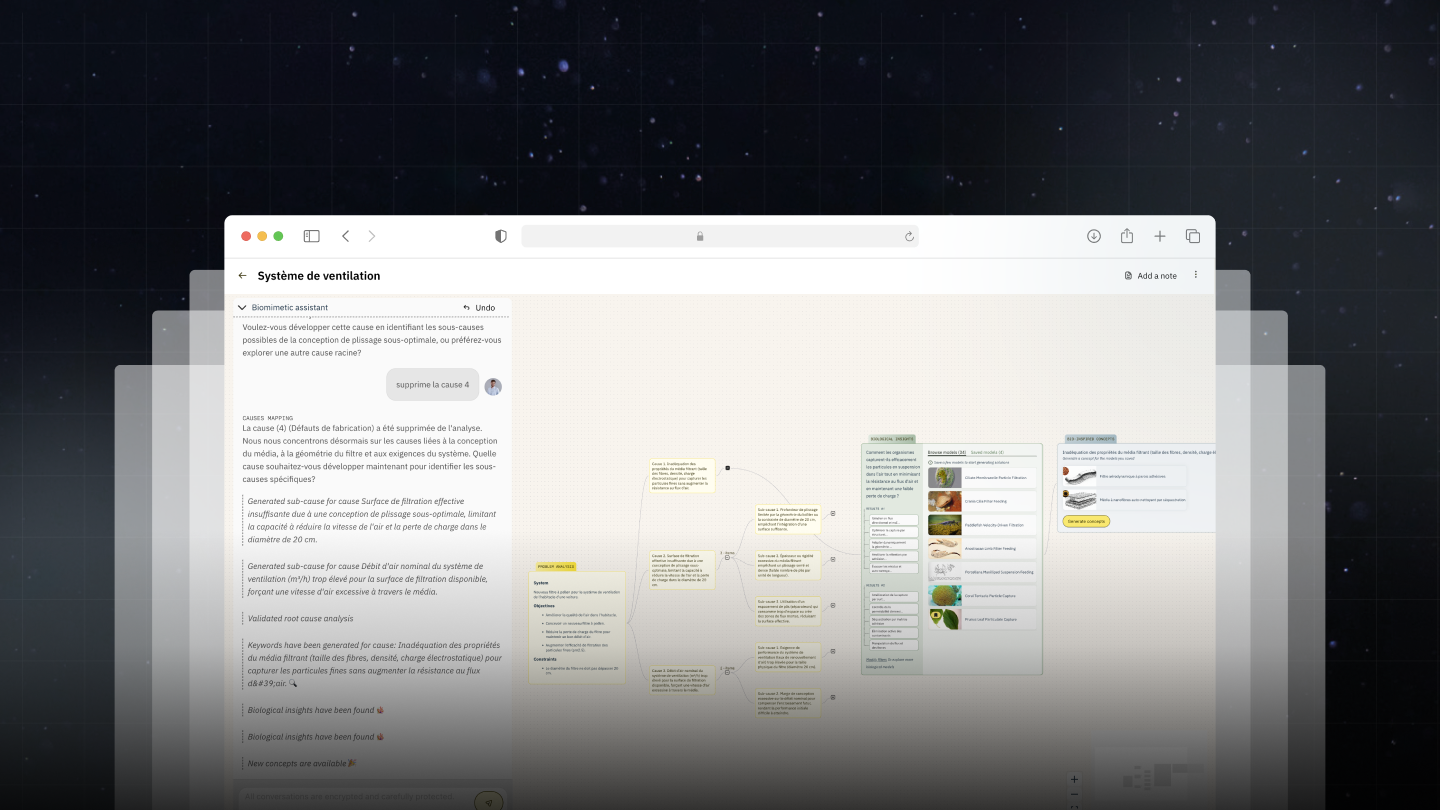
- Methodological structuring through Flow Project, a dedicated and more visual workspace designed to mirror and extend Chat interactions, allowing teams to organize insights, formalize hypotheses, and progress through deep-dive biomimicry projects in a structured, step-by-step manner.
- Long-term learning through My Library, a shared knowledge space where all insights, biological models, project outputs, and decisions generated across Asteria - whether through Chat, Flow Project, or other tools - are stored, structured, and made reusable over time.
This vision will take shape progressively, as biomimicry evolves from an experimental approach into a standard, reliable R&D practice.
In closing
Most biomimicry projects do not fail because biology has nothing to offer. They fail because exploration is too slow, too shallow, or too disconnected from industrial reality.
Asteria Chat exists to help teams explore the living world with more clarity, more discipline, and more confidence.
If you are simply curious, or you want to challenge a real project, let’s talk!
Frequently asked questions about biomimicry innovation

More posts about
Product & Practice

Collaborate with nature
GET a demo


.png)