
Par
Nicolas Morand
CPO @Asteria
Sustainable Solutions, Inspired by Nature: Explore Asteria
Introduction
What if your next big innovation was already out there, tested, refined, and proven by 3.8 billion years of evolution?
That’s the promise of biomimicry: learning from nature to solve today’s industrial, environmental, and societal challenges. But when we tried to implement biomimicry projects in practical terms, we ran into three big obstacles:
- Access to knowledge. All the biology is out there, but it’s buried in millions of scientific publications. They’re highly technical, written for biologists, not engineers or designers.
- Turning ideas into projects. Even if you find inspiration in nature, moving from “wow, that’s clever” to “here’s a functional product or process” is hard. Where do you start? How do you translate a cactus’ water conservation into specifications, material choices, or design principles?
- Collaboration. Biomimicry is inherently interdisciplinary. Designers, engineers, biologists, researchers, and project managers rarely have a shared workspace or language.
That’s why we created Asteria!
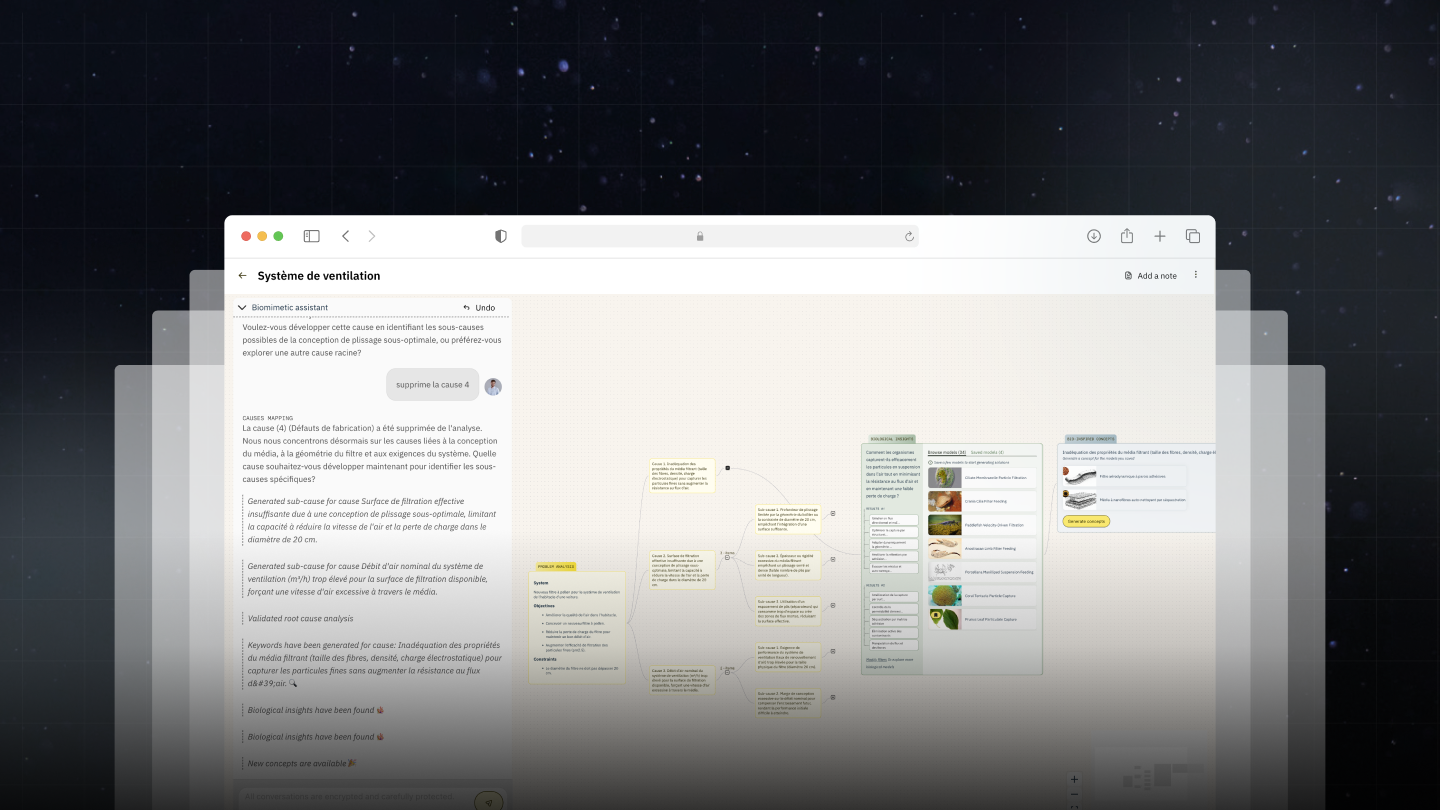
Asteria is an AI-powered platform designed to make biomimicry actionable. It guides you to define precisely your challenges, explore biological strategies, and translate them into industry-ready concepts, while enabling cross-disciplinary teams to work together.
In this guide, we’ll walk you step by step through the platform so you can see how it works in practice.
Who should use biomimicry for sustainable product development?
Biomimicry works best when the right people have the right tools. Whether you’re an R&D engineer, a design lead, a project manager, or a sustainability or innovation manager, Asteria helps you turn biological intelligence into tangible innovation outcomes.
Here’s how Asteria supports each role in making biomimicry practical and scalable.
Engineers: Spending weeks researching biological solutions buried in academic papers? Frustrated translating "how a lotus leaf repels water" into actual engineering specifications? Asteria gives you 60,000+ biological strategies already translated into technical terms. Find proven solutions for material strength, thermal management, or structural efficiency, without wading through biology jargon.
Innovation managers: Struggling to move biomimicry from "interesting concept" to "funded project"? Your team has ideas, but the process feels chaotic, and you can't demonstrate ROI to leadership. Asteria provides a systematic framework from challenge definition to validated concepts, with built-in sustainability scoring that makes the business case clear.
Designers: Caught between sustainability mandates and design excellence? "Eco-friendly" shouldn't mean compromising on aesthetics or user experience. Asteria shows you how nature creates solutions that are both functional and beautiful, giving you a foundation for products that are sustainable, manufacturable, and visually compelling.
Project managers: Coordinating engineers, designers, and consultants who speak different languages and work on different tools? Leadership demands proof that projects align with ESG commitments, but documentation is scattered. Asteria gives everyone a shared platform with automatic sustainability assessment and clear reporting from day one.
Step 1: Analyze and frame your sustainable innovation project
Every great biomimicry project starts with a clearly defined challenge. Let's say you want to improve the efficiency of solar panels, reduce packaging waste, or create a self-cooling building material.
When you create a project in Asteria, the AI-powered assistant guides you through a structured analysis:
- What system are you working with?
- What's your specific goal?
- What are your constraints: materials, costs, regulations, environmental standards, manufacturing capabilities…?
The AI doesn't hand you answers. It asks the right questions so you can articulate your challenge with precision. This matters because a well-framed problem leads to better biological models and more relevant solutions.
Mapping the root causes of your challenge
Before jumping to solutions, Asteria helps you dig deeper into why your challenge exists.
What would prevent you from reaching your goal? Which constraints matter most? Are there trade-offs you need to balance?
The platform builds a visual mind map of these root causes. This becomes your foundation for identifying biological strategies that address similar constraints in nature. For example, if your challenge involves "minimizing material use while maintaining strength," you'll explore how organisms like birds' bones or spider silk achieve exactly that.
Step 2: Discover biological models that solve similar problems
This is where Asteria's unique database becomes your innovation engine.
Understanding Asteria's database: quality over quantity
Not all biological research is relevant to innovation. We've built our database with rigorous quality filters:
- 300 million scientific articles indexed from trusted sources
- 1.3 million selected by AI for biomimicry relevance
- AI trained on 5,000 expert-curated publications from Ceebios, our scientific partner.
- Quality scoring based on citations, journal reputation, author H-index, and availability
- Continuous updates as new research is published
The result: 60,000+ biological models that are both scientifically rigorous and practically applicable.
How to search and filter biological strategies
Asteria gives you multiple ways to explore nature's solutions:
Search by function. Looking for UV protection? Water collection? Self-healing materials? Temperature regulation? Search by the function you need, and Asteria shows you every organism that has evolved a solution.
Search by species. Curious about a specific organism? Look up how sharks reduce drag, how butterflies create structural color, or how desert plants conserve water.
Filter by scale. Narrow your results by the level you're working at:
- Nano: molecular structures, proteins, chemical processes
- Micro: cellular mechanisms, tissue organization
- Macro: whole organisms, ecosystems, behavioral strategies
Filter by environment. Focus on organisms that thrive in conditions similar to your application: desert, ocean, forest, arctic, or urban environments.
What you'll find in each biological model
Every model sheet is designed to be actionable:
- Organism and habitat: What lives where, and why that context matters
- Challenge the organism faces: The evolutionary pressure that drove this adaptation
- Biological solution: The behavior, structure, material, or process the organism uses
- Functional strategies: How it works at a mechanical, chemical, or physical level
- Design principles: Engineering-friendly translations you can apply directly to your project
Example: The Saguaro cactus faces extreme heat and scarce water in the Sonoran Desert. Its solution? Pleated stem structure that expands to store water, waxy coating that minimizes evaporation, and shallow widespread roots that capture moisture efficiently. Design principles: Use expandable geometries for storage, apply hydrophobic coatings to reduce loss, maximize surface area for capture while minimizing exposure.
Step 3: Generate sustainable product concepts from nature
Once you've explored biological models and saved the ones that inspire you, it's time to generate actual concepts. This is where Asteria transforms inspiration into innovation.
AI-powered concept generation
Based on your project analysis, root causes, and selected biological models, Asteria's AI generates product or process concepts tailored to your challenge. These aren't vague ideas, they're structured proposals with:
- Clear design principles drawn from biological strategies
- Material and manufacturing process suggestions that could work in your application
- Sustainability assessment using the Framework for Strategic Sustainable Development (FSSD)
- Feasibility scoring across technical, economic, and innovation dimensions
- Bio-inspired patents and available technologies
Built-in sustainability from day one
Every concept generated in Asteria includes a sustainability evaluation based on the FSSD methodology. This ensures your innovation aligns with ecological principles and meets regulatory standards before you invest in prototyping.
You'll see how each concept impacts:
- Resource extraction and material flows
- Energy consumption and emissions
- Ecosystem health and biodiversity
- Social equity and economic viability
This isn't greenwashing, it's structural integration of sustainability into your innovation process.
Risk analysis and next steps
For each concept, Asteria provides:
- Strengths: What makes this approach promising?
- Weaknesses: Potential technical or practical limitations.
- Risks: What could go wrong during development or implementation?
- Next steps: Specific actions to move toward prototyping or validation.
You can compare concepts side-by-side, share them with your team for feedback, and refine them collaboratively within the platform.
Ready to see this in action? Book a demo to explore Asteria’s concept generator live.
Why Asteria is different from other biomimicry approaches
More than a search engine
You could use Google Scholar and spend weeks reading papers written for biologists. You could use ChatGPT and get generic answers with no source validation. Asteria gives you curated, translated, and actionable biological intelligence specifically for innovation teams.
More than inspiration
Many biomimicry resources stop at “nature is amazing”. Asteria takes you from challenge to concept to prototype-ready specifications. It's built for people who need to ship products, not just admire nature.
Built for collaboration, not solo work
Biomimicry is inherently interdisciplinary. Asteria provides a shared workspace, methodology, and language that lets engineers, designers, biologists, and project managers work together effectively.
Sustainability by design, not as an afterthought
Most innovative processes add sustainability considerations late, if at all. Asteria integrates FSSD assessment from the concept stage, so every idea you develop is aligned with ecological principles from the start.
Start transforming biological strategies into sustainable products today.
Biomimicry has the power to reshape how we innovate. But until now, it's been locked in academic papers, scattered expertise, and isolated projects.
Asteria changes that.
The platform gives you everything you need to discover nature's solutions, translate them into engineering principles, and develop sustainable products that actually work. You get:
- 60,000+ biological models curated and translated for practical application
- AI-powered methodology from challenge framing to concept generation
- Built-in sustainability assessment ensuring ecological alignment from day one
- Collaborative workspace where engineers, designers, and biologists can work together
- Continuous learning from the latest biomimicry research worldwide
Whether you're developing your first biomimicry project or scaling nature-inspired innovation across your organization, Asteria provides the structure, knowledge, and tools you need.
Ready to collaborate with nature?
Book a demo today and start your biomimicry journey with Asteria.
Frequently asked questions about biomimicry innovation
Biomimicry means learning from 3.8 billion years of evolution to solve today’s industrial and environmental challenges. It helps teams find proven strategies for efficiency, durability, energy use, and material reduction. Asteria makes this practical by translating biological intelligence into engineering-ready insights.
Asteria provides 60,000+ biological strategies already translated into technical terms. You can search by function, species, scale, or environment, then access model sheets with design principles ready for product development. This removes the need to dig through biology papers and helps teams move faster from idea to concept.
Asteria goes beyond inspiration. It offers curated biological models, AI-guided challenge framing, concept generation, and integrated sustainability scoring. It also gives teams a shared workspace, so engineers, designers, biologists, and managers work on the same information and methodology.
Every concept generated includes a sustainability assessment using the Framework for Strategic Sustainable Development. It evaluates resource use, energy, emissions, ecosystem impacts, and social factors. This ensures ecological alignment from the start rather than as an afterthought.
Asteria supports R&D engineers, designers, innovation managers, project managers, and sustainability leaders. It gives each role structured tools to define challenges, explore biological strategies, and build concepts that are technically feasible and sustainability-aligned.

More posts about
Product & Practice


Collaborate with nature
GET a demo


.png)